Traffic congestion is common across California highways, and many riders use lane splitting to move through slow traffic. But when a motorcycle lane-splitting accident occurs, determining who is legally responsible can become complicated. Riders, drivers, and insurance companies may all interpret the situation differently.
In 2023, about 82,564 motorcyclists were injured in traffic accidents across the U.S., highlighting the seriousness of these incidents. For California riders, understanding how liability works in motorcycle accidents is crucial when assessing legal rights, working with insurers, and safeguarding potential injury claims.
What California Law Says About Lane Splitting
California is the only U.S. state that explicitly recognizes lane splitting as legal. The rule is addressed under California Vehicle Code 21658.1.
The law defines lane splitting as:
Driving a motorcycle with two wheels touching the ground between rows of stopped or moving vehicles in the same lane, whether on divided or undivided roads.
The statute also allows the California Highway Patrol to develop safety guidelines for riders and drivers.
These guidelines emphasize:
- Safe rider judgment
- Awareness of surrounding vehicles
- Consideration of traffic conditions and traffic patterns
Although the law allows lane splitting, it does not automatically determine fault in a crash. Liability still depends on each party’s behavior before the incident.
When Lane Splitting Is Considered Safe and Lawful
In many situations, lane splitting is treated as a practical way to navigate traffic congestion. Safety recommendations suggest that riders follow certain precautions.
Typical speed recommendations include:
- Keeping the speed difference between motorcycles and vehicles minimal
- Avoiding aggressive maneuvers between tightly spaced cars
- Remaining alert for vehicles changing lanes
Motorcycle riders are also expected to watch for hazards such as:
- Drivers who fail to use turn signals
- Sudden braking
- Vehicles drifting between lanes
- Big rigs with large blind spots
When lane splitting is done cautiously and within reasonable limits, the rider is generally acting within California traffic laws.
Situations Where Drivers Are Typically Found at Fault
Drivers often share responsibility when they fail to notice a rider moving between lanes. Many motorcycle crash investigations identify common driver mistakes.
A driver may be liable if they:
- Change lanes suddenly without checking mirrors
- Ignore blind spots while merging
- Open vehicle doors into traffic
- Drive aggressively toward a motorcycle rider
These behaviors may violate state laws and constitute unsafe driving.
In these situations, an accident investigation may rely on evidence such as:
- Traffic camera footage
- Dash cam recordings
- Witness statements
Investigators may also evaluate the accident scene and traffic patterns through accident reconstruction.
When a Motorcyclist May Be Partially Responsible
Although lane splitting is legal, riders must still operate safely.
A motorcyclist may share fault if they:
- Ride at excessive speeds between lanes
- Ignore changing traffic conditions
- Pass vehicles too closely
- Attempt lane splitting in dangerous weather or bad road conditions
Other factors may include road hazards such as loose gravel or debris that affect control.
When a rider’s actions contribute to the collision, liability may be divided between the rider and the driver.
How Comparative Negligence Applies in Lane-Splitting Cases
California follows comparative negligence laws, specifically the pure comparative negligence system. This rule means that responsibility can be divided between multiple parties.
For example:
Party | Assigned Fault | Compensation Impact |
Driver | 70% | Pays the majority of damages |
Rider | 30% | Compensation reduced by 30% |
Under comparative negligence, injured motorcyclists can still recover compensation even if they are partially responsible.
However, their financial recovery may be reduced based on their share of fault. These negligence rules are often central to personal injury claims after motorcycle crashes.
Evidence That Strengthens a Lane-Splitting Injury Claim
Strong evidence is crucial to proving fault after a motorcycle lane-splitting accident.
Key evidence often includes:
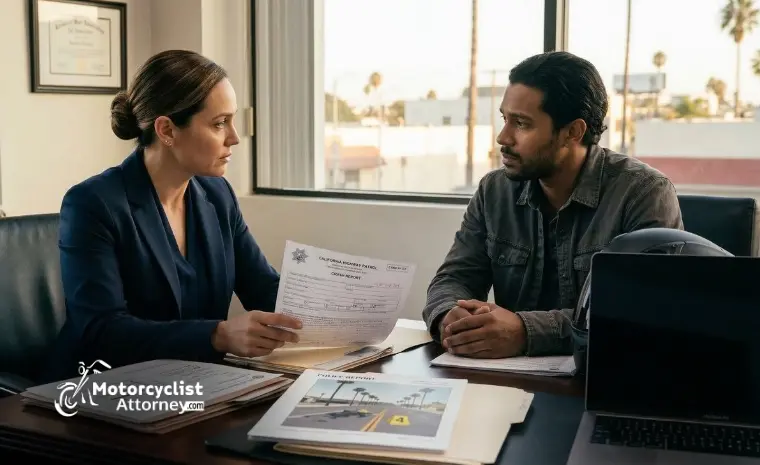
- Official accident report prepared by responding officers
- Traffic camera footage
- Surveillance footage from nearby buildings
- Dash cam video
- Eyewitness statements
- Photos of skid marks and vehicle positions
- Scene investigation reports
- Expert testimony from accident reconstruction specialists
An experienced legal team may conduct a full accident investigation to understand how the crash occurred. This process often includes analyzing traffic conditions, vehicle damage, and witness statements.
Common Insurance Arguments in Lane-Splitting Accidents
Insurance companies frequently dispute motorcycle accident claims. A claims adjuster may argue that the rider was responsible simply because they were splitting lanes.
Typical arguments include:
- Lane splitting is inherently dangerous
- The rider was traveling too fast
- The rider failed to anticipate traffic patterns
These claims can influence the claims process, especially when evaluating compensation for property damage and injuries.
Because of these challenges, many injured motorcyclists seek legal guidance when dealing with an insurance company.
How Liability Disputes Affect Compensation
Fault disputes can significantly affect the outcome of a personal injury claim.
Compensation in a motorcycle accident may cover:
- Medical treatment
- Lost wages
- Rehabilitation costs
- Property damage
However, disagreements over liability can delay settlement negotiations.
Legal professionals often review all evidence, including traffic footage, witness accounts, and expert testimony, to determine how comparative negligence should be applied. Working with a motorcycle accident lawyer in Culver City can help riders understand their legal rights and evaluate their options after a crash.
At Motorcyclist Attorney, we handle cases on a contingency fee basis, so clients generally pay legal fees only if we recover compensation.