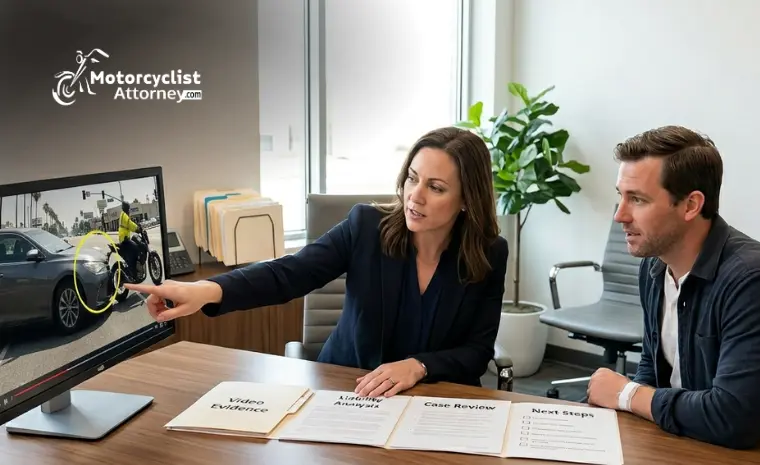
A split-second moment on the 405 or near the busy lanes of Sunset Boulevard can change everything—and when it does, evidence becomes critical. Many riders now rely on tools like a dash cam or nearby surveillance systems to prove fault in a motorcycle crash, especially when stories conflict.
In a city like Los Angeles, where traffic congestion and aggressive driving are common, clear footage can make the difference between a denied claim and rightful compensation. This article breaks down how video works in insurance claims and how it can support your case.
Why Video Evidence Is Critical in Motorcycle Accident Claims
Motorcycle crashes often come down to one issue: fault.
Drivers may deny responsibility. Witnesses may disagree. Insurance companies may push back.
That’s where video evidence becomes powerful.
It provides:
- A real-time record of the crash
- Objective details about positioning and timing
- Clear visuals of traffic violations
In Los Angeles traffic—whether on the I-10, US-101, or near Griffith Observatory—video footage can quickly cut through disputes.
Types of Dash Cam and Surveillance Footage Used in Motorcycle Crashes
Not all footage is the same. Different sources can help build a complete picture.
Common types include:
- Rider-installed dash camera systems (front-facing camera and rear camera)
- Built-in dash cams in nearby vehicles
- Traffic cameras at intersections like Hollywood & Highland
- Security cameras from businesses along city streets
- Residential surveillance systems in neighborhoods such as Echo Park or Silver Lake
- Footage from police vehicles during traffic stops
Each type can help prove what happened before, during, and after the crash.
How Dash Cam Footage Can Establish Fault
Dash cam footage is often the most direct evidence.
It can show:
- Lane changes without signaling
- Sudden braking leading to rear-end collisions
- Drivers running red lights
- Unsafe merging on freeways like the 110 or 5
Because a dash cam records continuously, it captures:
- Vehicle speed
- Driver behavior
- Road conditions
High video quality matters. Clear footage can reveal a license plate, the timing of impact, and even the driver’s awareness before the crash.
Features like night vision, loop recording, and cloud storage or microSD card backup help ensure the footage remains clear, accessible, and usable when needed.
When used correctly, it becomes strong video proof to prove fault in a motorcycle crash.
The Role of Traffic Cameras and Intersection Surveillance
Los Angeles has extensive traffic monitoring.
Cameras at major intersections and freeway ramps may capture:
- Signal changes
- Traffic flow patterns
- Violations such as running a red light
However, access is not automatic.
Footage is often:
- Controlled by local agencies or police departments
- Stored for a limited time
- Released only upon request
Timing is critical. Requests must be made quickly before the footage is overwritten.
Using Private Business and Residential Security Footage
Private surveillance is often overlooked but extremely valuable.
Think:
- Gas stations along Wilshire Boulevard
- Restaurants near Santa Monica Pier
- Apartment buildings in Downtown LA
These systems may capture angles that traffic cameras miss.
Advantages:
- Wider coverage of sidewalks and intersections
- Different vantage points
- Continuous recording
But access requires:
- Prompt outreach
- Formal requests
- Sometimes legal intervention
Legal Requirements for Obtaining Surveillance Video in California
California law allows video to be used in insurance claims, but it must meet strict legal standards.
Under California Evidence Code §§ 1400–1402, footage must be properly authenticated to confirm its source, accuracy, and reliability before it can be used as evidence. In addition, California Penal Code § 632 restricts recording confidential communications, which can impact audio captured on video.
To obtain footage:
- Attorneys may send preservation letters to businesses or property owners
- Subpoenas may be required to formally compel production
- Law enforcement reports may help identify nearby camera sources
Privacy considerations also apply.
For example:
- An audio recording without consent may be inadmissible
- Interior camera footage can raise privacy issues, depending on the location
Working with a motorcycle accident lawyer in Los Angeles helps ensure legal compliance while efficiently securing critical video evidence.
How Video Evidence Supports Comparative Negligence Arguments
California follows a comparative negligence system.
This means:
- Fault can be shared
- Compensation is reduced based on your percentage of fault
Video helps clarify:
- Who initiated the dangerous action
- Whether the rider contributed to the crash
For example:
- A driver cuts off a motorcycle near the 710 interchange
- Footage shows the rider maintained lane position
This can significantly reduce disputed liability.
In many cases, video evidence helps prove fault in a motorcycle crash more accurately than witness statements alone.
Authenticating and Admitting Video Footage in Court
Not all footage is automatically accepted.
To be admissible, it must be:
- Authentic (verified source)
- Untampered
- Relevant to the incident
Attorneys typically:
- Confirm timestamps
- Validate device origin (dash cam, security system, etc.)
- Establish a chain of custody
Even details like video recording format or storage method (cloud storage vs microSD card) can matter.
Preserving Video Evidence Before It Is Deleted or Overwritten
Most systems do not store footage forever.
Some overwrite data within:
- 24–72 hours (traffic cameras)
- A few days (private systems with loop recording)
Immediate action steps:
- Identify possible camera sources
- Contact property owners quickly
- Save your own dash cam footage immediately
- Work with an attorney who can help obtain and preserve critical evidence
- Avoid relying solely on insurance companies
Delay can mean losing critical proof.
How Attorneys Use Video Footage to Strengthen Settlement Negotiations
Insurance companies respond differently when clear evidence is presented.
With strong video proof, attorneys can:
- Challenge inaccurate reports
- Push back against low settlement offers
- Demonstrate liability clearly
This is especially important in Los Angeles, where high traffic volume increases the likelihood of disputed claims.
Video reduces ambiguity—and that shifts the balance of power in negotiations.
When Video Evidence Can Lead to Faster Case Resolution
Cases supported by video often move faster.
Why?
Because:
- Liability is clearer
- Fewer disputes arise
- Insurance companies have less room to deny claims
In some situations, strong footage can lead to:
- Early settlement
- Reduced litigation time
- Lower legal costs
When used strategically, it helps efficiently prove fault in a motorcycle crash.