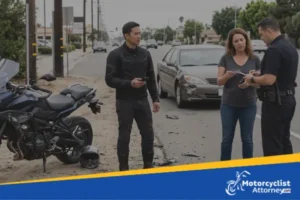

It happens fast. One moment you’re riding through traffic near the US-101, the next you’re on the pavement, trying to piece together what went wrong. Days later, the calls start. Insurance companies question your speed, reaction time, and decision-making.
When the story becomes disputed, ECM data (Engine Control Module data), often called “black box data,” can help reconstruct what happened before and during a collision.
In this guide, you’ll learn how it reveals speed and braking patterns, how it’s preserved, its limitations, and how legal strategy can turn this data into stronger claims. In many cases, this data may be one of the only objective ways to reconstruct what actually happened.
What Is ECM Data?
In a motorcycle accident context, ECM data refers to information stored in a vehicle’s Engine Control Module (ECM) or Electronic Control Unit (ECU)—the onboard computer that monitors engine performance and system behavior. This information is often associated with “black box” technology, also known as Event Data Recorders (EDRs).
According to the National Highway Traffic Safety Administration (NHTSA), EDRs can record technical vehicle and occupant data for a short period before, during, and after a crash—helping explain how the collision occurred.
What Types of Data Can Be Retrieved After a Crash?
In a California motorcycle accident claim, available ECM data can provide detailed insight into how a crash unfolded. However, not every vehicle stores the same information, and data availability depends on the ECM system, vehicle type, and manufacturer.
Data Type | Why It Matters |
Vehicle speed | Helps dispute or confirm speeding allegations |
Brake Usage / Hard Braking Events | Shows driver reaction and avoidance attempts |
Engine RPM/gear shifts | Supports accident reconstruction analysis |
Fault Codes / diagnostic trouble codes | May reveal mechanical or sensor issues |
GPS and route information | Helps establish vehicle position before impact |
This type of data can strengthen the evaluation of accident claims.
Using ECM Data to Prove or Dispute Fault
In a California motorcycle accident claim, ECM data can play a key role in confirming or challenging the circumstances of a crash. Because it captures objective vehicle behavior, it is often used during accident reconstruction and claim evaluation.
It can help analyze:
- Vehicle speed before impact to address speeding claims
- Braking patterns and Hard Braking Events to show reaction time
- Indicators related to distracted driving or delayed response
- Crash pulse data to understand impact severity and timing
Insurance companies often rely on this data when evaluating accident claims, making it a powerful tool in disputed cases.
How Black Box Evidence Supports Comparative Fault Arguments
In a California motorcycle accident claim, ECM data and black box data can directly affect how fault is divided under comparative negligence rules.
It is often used to evaluate:
- Whether the rider was speeding before impact
- How quickly braking occurred (reaction time)
- Whether the other driver’s actions contributed to the crash
Why this matters:
- A higher fault percentage = lower compensation
- A lower fault percentage = stronger settlement value
For example, if a driver claims the motorcyclist was speeding, ECM data from the involved vehicle may confirm or contradict that claim—directly influencing how insurance companies assign responsibility.
Preserving and Downloading ECM Data After a Crash
In a California motorcycle accident claim, acting quickly to preserve ECM data is critical. This information can be lost if not secured in time.
Key risks include:
- Data is being overwritten by the vehicle’s system
- Vehicle repairs that may erase or damage stored data
- Delays that prevent proper ECM data downloads
To protect this evidence, legal teams may send a spoliation letter requiring preservation. Extracting the data also requires specialized diagnostic software and qualified experts, along with a proper chain of custody to ensure it can be used in accident claims.
Who Can Access ECM or Black Box Data in California?
In a California motorcycle accident claim, access to ECM data or black box data is not automatic. Under California Vehicle Code §9951, vehicles equipped with Event Data Recorders (EDRs) must disclose their presence, but that does not mean the data is freely available.
In most cases, accessing ECM data requires:
- Owner’s consent for the vehicle involved
- A court order or legal request during litigation
- Early preservation steps by legal teams
Because this process can be complex, securing access to this data often depends on timely legal action.
Limitations and Challenges of Interpreting ECM Data
While ECM data can be powerful in a California motorcycle accident claim, it is not always complete or easy to interpret. Understanding its limits is essential when evaluating accident claims.
Common challenges include:
- Data may be incomplete or only capture seconds before impact
- Motorcycles may store less crash data than passenger vehicles
- ECM fault codes require expert analysis to understand their meaning
- Black box data can be misinterpreted without proper accident reconstruction
Because of these limitations, ECM evidence is most effective when combined with other supporting proof.
Why ECM Evidence Strengthens Settlement Negotiations
In a California motorcycle accident claim, ECM data provides objective evidence that can significantly strengthen your position during negotiations. Unlike conflicting statements, this data shows measurable facts about vehicle performance.
This matters because:
- It reduces “he said/she said” disputes
- Supports clearer liability determinations
- Helps justify damages and claim value
When used effectively, ECM data can give injured riders stronger leverage against insurance companies during settlement discussions.
How a Motorcycle Accident Lawyer in Los Angeles Can Help
After a crash in dense traffic areas like the I-10, I-405, or US-101, a skilled motorcycle accident lawyer in Los Angeles can play a critical role in protecting your California motorcycle accident claim—especially when ECM data is involved.
An expert legal team can help by:
- Identifying whether recoverable ECM data or black box data exists
- Acting quickly to preserve critical evidence before it is lost
- Coordinating accident reconstruction using technical data
- Challenging insurer narratives based on incomplete information
- Protecting the proper chain of custody for admissibility
This strategy helps turn complex data into stronger claims.