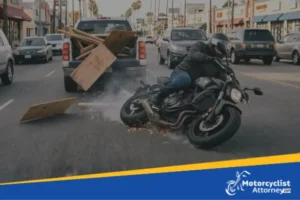
A piece of lumber falling from a truck on Interstate 5, scattered tire fragments along the 405 Freeway, or loose gravel near Sunset Boulevard can turn an ordinary ride into a dangerous situation. A road debris motorcycle accident may occur in seconds, leaving the rider little time to avoid a collision.
Unlike drivers in enclosed vehicles, motorcyclists have limited protection when they strike an unexpected object or lose traction on damaged pavement. Even small obstacles can affect a motorcycle’s balance and steering.
California’s extensive freeway network, commercial traffic, and heavily traveled city streets make roadway hazards a concern for riders throughout Los Angeles and surrounding communities.
But who pays when debris causes a motorcycle crash?
The answer depends on the source of the hazard, whether another party failed to exercise reasonable care, and what insurance coverage is available.
What Causes a Road Debris Motorcycle Accident?
Road debris includes objects or materials left on a roadway that may interfere with safe travel.
Some hazards fall from vehicles, while others result from poor road conditions, construction activity, or damaged infrastructure.
Common examples include:
- Unsecured cargo: Furniture, lumber, appliances, or tools falling from pickup trucks and trailers
- Tire debris: Tread fragments or damaged tires left behind by passenger vehicles and commercial trucks
- Construction materials: Loose gravel, metal pieces, or equipment near active roadwork
- Potholes: Broken pavement or deep depressions that may cause riders to lose control
- Vehicle parts: Detached bumpers, exhaust components, or other mechanical parts
- Roadway obstructions: Fallen branches or other objects that responsible parties may have failed to address
Motorcyclists may crash either by directly striking an object or by attempting to avoid it.
Lane splitting, which is permitted in California when performed safely, can introduce additional challenges when debris is present between traffic lanes. Riders may have less room to maneuver around an unexpected object, especially in congested traffic.
The cause matters because different liability and insurance rules may apply depending on whether the hazard came from a moving vehicle or an existing roadway condition.
Unsecured Loads: When Another Driver Is Liable
California law requires drivers to secure transported materials to prevent unnecessary hazards to other road users.
Under California Vehicle Code §23114, vehicles generally must be loaded and operated to prevent cargo from dropping, sifting, leaking, or otherwise escaping onto the highway, subject to statutory exceptions.
Who Pays When Cargo Falls From a Vehicle?
If a driver fails to secure a load and the falling cargo causes a motorcycle collision, that driver may be responsible for resulting damages.
For example, a motorcyclist traveling on the 101 Freeway may strike a wooden board that falls from an improperly secured pickup truck.
If the evidence establishes that the driver negligently transported the board and caused the crash, the driver’s liability insurance may provide compensation, subject to policy limits and other coverage issues.
Can a Trucking Company Also Be Responsible?
When debris falls from a commercial truck, responsibility may extend beyond the driver.
Potentially liable parties may include:
- The truck driver who failed to inspect or secure the load
- The trucking company responsible for the driver’s work
- A cargo-loading company that improperly secured the materials
- Another business whose negligence contributed to the hazard
Liability depends on the parties’ actual responsibilities and the circumstances of the collision.
A commercial vehicle’s involvement does not automatically make every associated company responsible.
What if the Driver Leaves the Scene?
Identifying the vehicle becomes more difficult when the driver continues without stopping.
Witness statements, dashboard-camera footage, nearby surveillance recordings, and vehicle descriptions may help investigators determine where the debris originated.
If the responsible driver cannot be identified, your own insurance coverage may become particularly important.
Potholes and Road Hazards: Claims Against the City or Caltrans
Not every motorcycle crash involving roadway debris is caused by another driver.
Some accidents involve potholes, deteriorating pavement, loose construction materials, or hazards that may fall within a public agency’s maintenance responsibilities.
When Is a Government Agency Responsible?
California Government Code §835 establishes conditions under which a public entity may be liable for injuries caused by a dangerous condition of public property.
Generally, the injured person must establish that:
- The property was in a dangerous condition at the time of the injury
- The condition created a reasonably foreseeable risk of the type of injury that occurred
- The dangerous condition caused the injury
- The agency’s negligent conduct created the condition, or the agency had actual or constructive notice and sufficient time to take protective measures
Additional legal defenses and exceptions may apply.
For example, a rider who encounters a long-standing pothole on a city-maintained street may have a potential claim if the evidence establishes the required elements.
However, a pothole’s existence alone does not prove government liability.
Is Caltrans Responsible for Every Freeway Hazard?
No. The California Department of Transportation, commonly called Caltrans, maintains many state highways and freeways, but it is not automatically responsible for every object or hazard that appears on them.
A recently fallen object may not have been present long enough for the agency to discover and address it.
The investigation must determine who controlled the roadway, how the hazard developed, and whether the legal requirements for liability are satisfied.
Motorcyclists can report hazards through the Caltrans Customer Service Request system.
Government Claims Have Shorter Deadlines
California Government Code §911.2 generally requires a personal injury claim against a public entity to be presented within six months of the injury.
This administrative claim requirement is separate from the ordinary statute of limitations for filing many personal injury lawsuits.
Under California Code of Civil Procedure §335.1, most personal injury lawsuits generally have a two-year filing deadline, although exceptions may apply.
Missing a government-claim deadline can affect the right to pursue compensation, even if the ordinary two-year period has not expired.
Because identifying the responsible public agency can take time, early investigation is particularly important.
Using Your Own Insurance After a Road Debris Motorcycle Accident
Even when another party may be responsible, your own motorcycle insurance could provide an initial source of coverage.
The available benefits depend on your policy and how the collision occurred.
Collision Coverage
Collision insurance may help pay for motorcycle repairs when the bike strikes an object or overturns, subject to the deductible and policy terms.
This coverage may be useful while liability is being investigated.
Uninsured/Underinsured Motorist Coverage
Uninsured/underinsured motorist coverage may provide financial protection when another driver causes a collision but has no insurance or insufficient liability coverage.
However, a crash caused by unidentified debris does not automatically qualify for uninsured motorist benefits.
California policies may require physical contact with an unidentified vehicle for certain hit-and-run claims, and other coverage conditions can apply.
Underinsured motorist coverage may become relevant when an identified at-fault driver has insufficient liability insurance.
Medical Payments Coverage
If included in the policy, medical payments coverage may help pay qualifying accident-related medical bills regardless of fault, subject to coverage limits and exclusions.
What if Insurance Denies the Claim?
An insurer may dispute whether the motorcycle struck a covered object, whether the incident meets the policy’s definition of a collision, or whether sufficient evidence establishes the cause.
Review the denial explanation and applicable policy provisions before deciding how to proceed.
Evidence That Proves Who Is Responsible
A successful motorcycle accident claim often depends on establishing how the hazard reached the roadway and who had responsibility for preventing or removing it.
If you are physically able and the location is safe, useful evidence may include:
- Photographs of the debris and roadway. Capture the object’s position, surrounding lanes, pavement damage, and visible traffic controls
- Vehicle information. Record license plates, company names, or identifying details if a vehicle dropped the object
- Witness statements. Obtain contact information from people who observed the cargo falling or the collision occurring
- Camera footage. Preserve helmet-camera, dashboard-camera, or nearby business surveillance recordings
- Police reports. Request the collision report and verify that relevant details about the roadway hazard were documented
- Maintenance records. For potential public-property claims, relevant inspection, repair, and complaint records may help establish notice
- Repair and medical records. Keep estimates, invoices, treatment documentation, and records of missed work
Depending on where the crash occurred, the California Highway Patrol (CHP) or a local law enforcement agency may investigate the collision.
The CHP frequently handles crashes on state highways and freeways. Its collision reports may contain information about road conditions, vehicle involvement, witness accounts, and other relevant details.
Why Early Evidence Preservation Matters
Debris may be removed shortly after an accident. Road crews may repair a pothole, and surveillance systems may overwrite recordings.
An attorney may be able to send preservation requests, investigate the source of the hazard, and pursue relevant records through available legal procedures.
Do not enter active traffic lanes or place yourself in danger to photograph or retrieve debris.
For additional information about documenting motorcycle collisions, read Can Scene Photos and Skid Marks Help Prove Liability?.
What Compensation Can Motorcycle Riders Recover?
If another party’s negligence caused the accident, a motorcyclist may be able to pursue compensation for economic and noneconomic damages.
Motorcycle crashes involving road debris may cause injuries ranging from road rash and fractures to more serious conditions such as a brain injury, spinal cord injuries, or internal injuries.
Some injuries may not be immediately apparent after a crash, making prompt medical evaluation important.
Depending on the evidence, recoverable losses may include:
- Emergency care, hospitalization, and other reasonable medical expenses
- Future treatment and rehabilitation costs
- Lost wages and reduced earning capacity
- Motorcycle repair costs or qualifying total-loss value
- Damaged protective gear and other personal property
- Physical pain and suffering
- Other legally recoverable accident-related losses
The value of a claim depends on the injuries, available evidence, liability, insurance coverage, and applicable law.
Learn more about recoverable financial losses in Economic Damages in Motorcycle Accident Claims.
What if the Motorcyclist Swerved to Avoid the Debris?
A rider does not necessarily have to strike the debris to have a potential claim.
If another driver’s unsecured cargo created an immediate hazard and the rider reasonably swerved to avoid it, the responsible party may still be liable for a resulting crash.
However, investigators must establish a connection between the hazard and the collision.
California’s comparative fault rules may also apply if the rider’s conduct contributed to the accident. Compensation can be reduced according to the rider’s percentage of responsibility.
When to Call an Attorney for Motorcycle Accidents in California
Determining responsibility can be difficult when several vehicles, businesses, or public agencies may be involved.
An attorney for motorcycle accidents California riders consult can review the circumstances and explain whether a personal injury claim may be available.
Legal assistance may be especially useful when:
- The driver responsible for dropping the debris cannot be identified
- A commercial truck or cargo-loading company may be involved
- A pothole or roadway maintenance issue contributed to the crash
- Insurance companies dispute coverage or liability
- The injuries require ongoing treatment or cause substantial lost income
- A government-claim deadline may apply
Our law firm experienced in motorcycle injury cases can help investigate the source of the hazard, evaluate insurance policies, identify potentially liable parties, and explain the steps needed to preserve a claim.
Depending on the circumstances, legal representation may involve reviewing collision reports, obtaining maintenance records, consulting accident reconstruction professionals, and communicating with insurers.
Vehicle data may also provide useful evidence in certain cases. Learn more in What Is ECM Data & Can It Help Your Motorcycle Injury Case?.
How Are Motorcycle Accident Attorneys Paid?
Many personal injury attorneys handle eligible cases on a contingency fee basis, meaning attorney fees are generally calculated as an agreed percentage of the recovery rather than charged upfront.
The exact arrangement depends on the written fee agreement. Clients should review how litigation expenses, case costs, and other financial responsibilities will be handled.
For crashes involving roadway defects, early legal review may be particularly important because public-entity claim deadlines can be much shorter than ordinary personal injury filing periods.