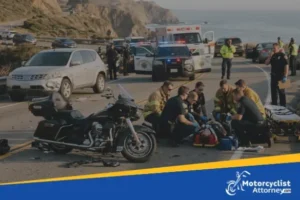
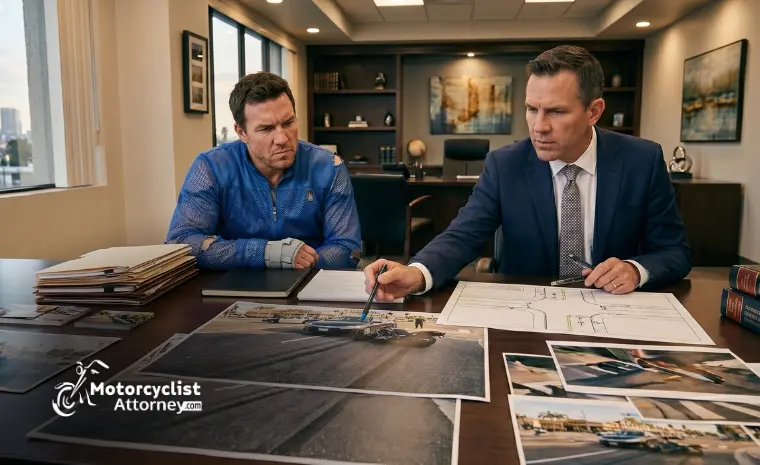
Motorcycle accidents often happen in seconds, but the evidence left behind can tell a detailed story. After a crash, investigators, insurance companies, and attorneys look at physical evidence to understand the events leading up to the collision.
Two of the most important forms of evidence are scene photographs and skid marks from a motorcycle accident. Together, they can help demonstrate what happened, who acted negligently, and ultimately who may be responsible for the accident.
For riders wondering how to prove liability in motorcycle accident claims, preserving evidence at the scene can make a significant difference.
Why Physical Evidence Matters After a Motorcycle Crash
When drivers and riders provide conflicting accounts of an accident, physical evidence becomes critical. Unlike personal recollections, physical evidence often provides objective information about the events leading up to a collision.
Evidence from the crash scene may help answer questions such as:
- Which vehicle had the right of way?
- Was the driver speeding?
- Did someone brake before impact?
- Where did the collision occur?
- Did a vehicle drift into another lane?
Photographs, road markings, vehicle damage, and debris patterns can all help reconstruct the accident.
What Can Skid Marks Reveal?
One reason investigators pay close attention to skid marks is that they often show how a vehicle reacted before impact.
Depending on the circumstances, skid marks from a motorcycle accident may indicate:
- Sudden braking
- Attempted evasive maneuvers
- Estimated vehicle speed
- Direction of travel
- Point of impact
For example, long skid marks may suggest that a driver had enough time to see the road hazard and attempted to stop. Conversely, the absence of skid marks could sometimes indicate distraction, impairment, or delayed reaction time.
Accident reconstruction experts often use skid mark measurements alongside other evidence to better understand how the crash occurred.
Investigators may also look for acceleration marks, which are tire marks left when a vehicle rapidly increases speed. While skid marks often indicate braking, acceleration marks can suggest aggressive driving, racing, or an attempt to enter traffic quickly before a collision.
The condition of the roadway and the type of tire compounds involved may also affect the appearance of tire marks. Different tires interact with pavement differently, which can provide additional clues during an accident investigation.
How Scene Photos Support Liability Claims
Photos taken immediately after a crash can preserve important details that may disappear within hours.
Helpful photographs often include:
- Vehicle positions
- Damage to motorcycles and cars
- Road conditions
- Traffic signs and signals
- Weather conditions
- Debris fields
- Tire marks on the roadway
These images create a visual record of the accident scene. They can help insurance adjusters, attorneys, and experts analyze the circumstances surrounding the collision.
If you are physically able after a crash, taking photos can be one of the most important steps you take to protect your claim.
How Experts Use Photos and Tire Marks Together
Accident reconstruction specialists rarely rely on a single piece of evidence.
Instead, they examine:
- Scene photographs
- Vehicle damage
- Witness statements
- Traffic camera footage
- Event data recorders
- Police reports
- Roadway evidence
When scene photos clearly document tire marks, experts can compare those marks with vehicle positions and impact damage. This process helps create a more accurate picture of what happened.
In many motorcycle accident cases, combining multiple sources of evidence produces stronger conclusions than relying on witness testimony alone.
How Accident Reconstruction Experts Analyze Crash Evidence
In more complex motorcycle accident cases, attorneys may work with accident reconstruction specialists to determine exactly how a collision occurred. These professionals use scientific methods and engineering principles to perform a reconstruction of accident events.
Their analysis may include:
- Scene photographs and videos
- Vehicle damage patterns
- Roadway measurements
- Witness statements
- Electronic vehicle data
- Police reports
- Tire mark analysis
Some investigations may even involve forensic engineering, a specialized field that applies engineering principles to determine the causes of accidents and mechanical failures.
Experts often evaluate factors such as vehicle movement, braking distance, and roadway conditions to create a detailed timeline of events leading up to the crash.
To estimate impact speed, reconstruction experts may analyze skid mark length, roadway conditions, vehicle damage, and other physical evidence. They may also apply a calculation known as the drag factor, which measures the amount of friction between tires and the road surface. This information can help determine how fast a vehicle was traveling before impact.
What Other Physical Evidence Can Help Prove Fault?
While scene photos and skid marks from a motorcycle accident are important, investigators often seek additional physical evidence.
One example is a tire impression, which occurs when a tire leaves a visible pattern on the roadway, shoulder, dirt, or another surface. Tire impressions can help identify vehicle movement and positioning before impact.
Investigators may also examine trace evidence, including:
- Paint transfers
- Broken vehicle parts
- Glass fragments
- Road debris
- Clothing fibers
These small details can help confirm how vehicles came into contact and support witness accounts of the collision.
When combined with photographs and police documentation, physical evidence can provide a clearer picture of who may be responsible for the crash.
Why the Police Report Is Critical in a California Motorcycle Accident Claim
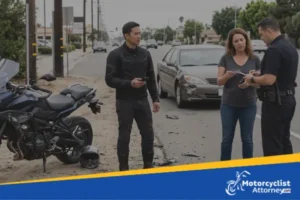
One of the most valuable documents after a crash is the official police report.
Law enforcement officers often document:
- Road conditions
- Statements from drivers and witnesses
- Preliminary fault assessments
- Measurements from the scene
- Visible tire marks and debris
The report may also reference photographs, diagrams, and observations that support your claim.
Although a police report does not automatically determine fault, insurance companies frequently review it during their investigations.
For California riders wondering how to prove liability in motorcycle accident claims, the police report often serves as a foundational piece of evidence that supports other documentation gathered after the crash. The California Highway Patrol (CHP) provides resources for collision reporting and traffic safety information that may be helpful after an accident.
Other Evidence That Can Help Establish Fault
While scene photos and tire marks are important, they are only part of the larger picture.
Additional evidence may include:
- Helmet camera footage
- Dashcam recordings
- Traffic surveillance videos
- Cell phone records
- Medical records
- Expert testimony
- Vehicle inspection reports
The stronger the evidence collection, the easier it may be to demonstrate negligence and establish liability.
This is especially important in California’s comparative negligence system, where multiple parties may share fault for an accident.
What Should Motorcyclists Do After a Crash?
The actions you take immediately after an accident can affect your ability to recover compensation later.
If possible:
- Move to a safe location.
- Call 911.
- Seek medical attention.
- Photograph the scene.
- Gather witness information.
- Obtain the police report number.
- Avoid discussing fault at the scene.
- Contact an attorney before speaking extensively with insurance adjusters.
Prompt evidence collection helps preserve details that may disappear quickly after a crash.
How a Motorcycle Accident Attorney Can Help
Determining fault is not always straightforward. Insurance companies may dispute liability, minimize injuries, or attempt to shift blame onto the rider.
Our experienced Culver City motorcycle accident lawyer can investigate the crash, preserve evidence, work with reconstruction experts, and build a case supported by facts.
For riders seeking answers on how to prove liability in motorcycle accident claims, legal guidance can help ensure critical evidence is collected before it is lost.
Our accident experts can also help gather witness statements, obtain traffic camera footage, review police reports, and negotiate with insurance companies on your behalf.