
You’re riding straight through Los Angeles traffic—maybe along Sunset Blvd or approaching an intersection near the I-10 or I-405—when a driver suddenly turns left across your lane. In a split second, a routine ride becomes a serious collision.
These situations are known as left-turn motorcycle accidents, one of the most common and dangerous types of crashes for motorcyclists. In California, determining who had the right of way is critical, but fault is often disputed.
In this guide, you’ll learn how California law applies, how liability is determined, what evidence matters, and what legal options may be available after a crash.
Why Left-Turn Motorcycle Accidents Are So Common at California Intersections
Left-turn motorcycle accidents are especially common at busy California intersections, where drivers must quickly judge speed, distance, and traffic gaps. Many motorists miscalculate how fast a motorcycle is approaching or fail to see it due to visibility problems.
Common causes include:
- Drivers misjudge motorcycle speed
- Limited visibility in dense city traffic
- Poor timing when turning across traffic lanes
According to the National Highway Traffic Safety Administration (NHTSA), many multi-vehicle motorcycle crashes occur because drivers simply do not detect the motorcyclist in time. In cities like Los Angeles, these crossing-path collisions are one of the leading causes of serious accidents.
Understanding Right-of-Way Laws in California for Left-Turn Motorcycle Accidents
In left-turn motorcycle accidents, California law sets a clear rule at intersections. Under California Vehicle Code Section 21801, a driver making a left turn must yield the right of way to any oncoming vehicle that is close enough to create a hazard.
This includes motorcycles. A motorcyclist traveling straight has the same legal protection as any other vehicle in that lane.
What this means in practice:
- Drivers must wait until it is safe before turning left
- Misjudging speed or distance does not remove that duty
- Failing to yield often establishes liability in the collision
However, insurers may still consider factors such as speed, visibility, and rider behavior when evaluating fault.
When Drivers Must Yield to Motorcycles in Left-Turn Motorcycle Accidents
In left-turn motorcycle accidents, drivers have a legal duty to yield the right of way in several common situations at intersections. Failing to do so is often a key factor in determining liability.
Drivers must yield when:
- Turning left across oncoming traffic
- Entering or crossing traffic lanes
- Misjudging the distance or speed of an approaching motorcyclist
- Turning on a stale yellow light or after a traffic signal change
When drivers fail to yield under these conditions, they are often considered negligent, making yield violations a central issue in many motorcycle accident claims.
Common Scenarios Where Fault Is Disputed in Left-Turn Motorcycle Accidents
In left-turn motorcycle accidents, liability is not always straightforward. Even when a driver fails to yield, insurers often look for ways to assign partial responsibility to the motorcyclist under comparative fault principles.
Common disputed scenarios include:
- Allegations of excessive speed by the motorcyclist
- Visibility problems in busy intersections or low-light conditions
- Disputes over the rider’s lane of travel
- Claims that the rider failed to take proper evasive maneuvers or other safety strategies
- Arguments involving driver distraction vs. rider reaction time
Even when the left-turning driver was negligent, these factors can still reduce compensation in motorcycle accident claims.
Evidence That Proves Fault in Left-Turn Motorcycle Accidents
In left-turn motorcycle accidents, proving what actually happened is often more important than what each driver claims. Because visibility is frequently disputed, strong evidence plays a critical role in establishing fault and protecting the motorcyclist’s legal rights.
Key evidence includes:
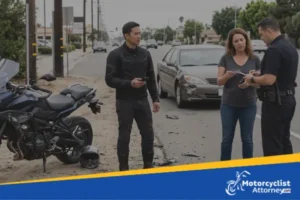
- Police reports from the initial investigation
- Witness statements or eyewitness testimony
- Traffic camera footage, dashcam footage, or video surveillance
- Skid marks and physical evidence from the scene
- Vehicle damage patterns and accident reconstruction analysis
- Traffic signal timing data at the intersection
When properly documented, this evidence can challenge insurer narratives and support a stronger motorcycle accident claim.
Injuries Common in Left-Turn Motorcycle Accidents
Motorcycle accidents often result in serious injuries due to the direct impact and limited protection for the rider at intersections.
Common injuries include:
- Traumatic brain injuries
- Fractures and compound fractures
- Road rash from sliding across pavement
- Spinal cord injury or spinal cord damage
- Internal injuries, including internal organ damage
Because these collisions frequently involve crossing-path impact forces, injuries tend to be severe, often leading to significant medical expenses and long-term recovery challenges.
What Riders Should Do After Left-Turn Motorcycle Accidents
After left-turn motorcycle accidents, taking the right steps can protect both your health and your motorcycle accident claim.
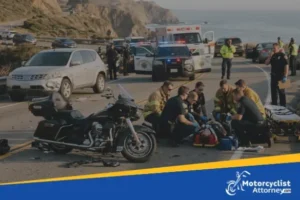
- Call the police and request immediate medical response
- Seek hospital care for any injuries, even if they seem minor
- Photograph the scene, motorcycle, helmet, and protective gear
- Collect witness statements and contact information
- Preserve police reports, investigation records, and any traffic citation data
These steps help document the collision and strengthen your position when dealing with insurance claims and liability disputes.
How a Motorcycle Accident Lawyer in Los Angeles Helps After Left-Turn Motorcycle Accidents
After left-turn motorcycle accidents, working with a skilled motorcycle accident lawyer in Los Angeles can make a critical difference—especially in dense city traffic near intersections and freeway corridors like the I-10, I-405, or US-101.
A legal team can help by:
- Proving right-of-way violations under California law
- Coordinating accident reconstruction to clarify how the collision occurred
- Pushing back on comparative fault claims from insurers
- Accurately valuing damages, medical expenses, and lost wages
- Negotiating your insurance claim or preparing a personal injury lawsuit
This support helps protect your rights and maximize your recovery after a crash.